Read the original article in Japanese
English adaptation of an October 9, 2026 Japanese article. All metrics below describe the specific historical windows stated here, not the current traffic of ichigoro.com.
Before writing this entry, I had 28 published articles. Yet the confirmed Google Search data showed one click across the period I could examine.
That click went to an older article, not one of my recent posts. Rather than publish even more material and hope for a different result, I decided on October 9 to find out what I could—and could not—actually measure.
This is the first entry in the site's growth log. It records the baseline and the measurement work, not a success story about traffic or revenue.
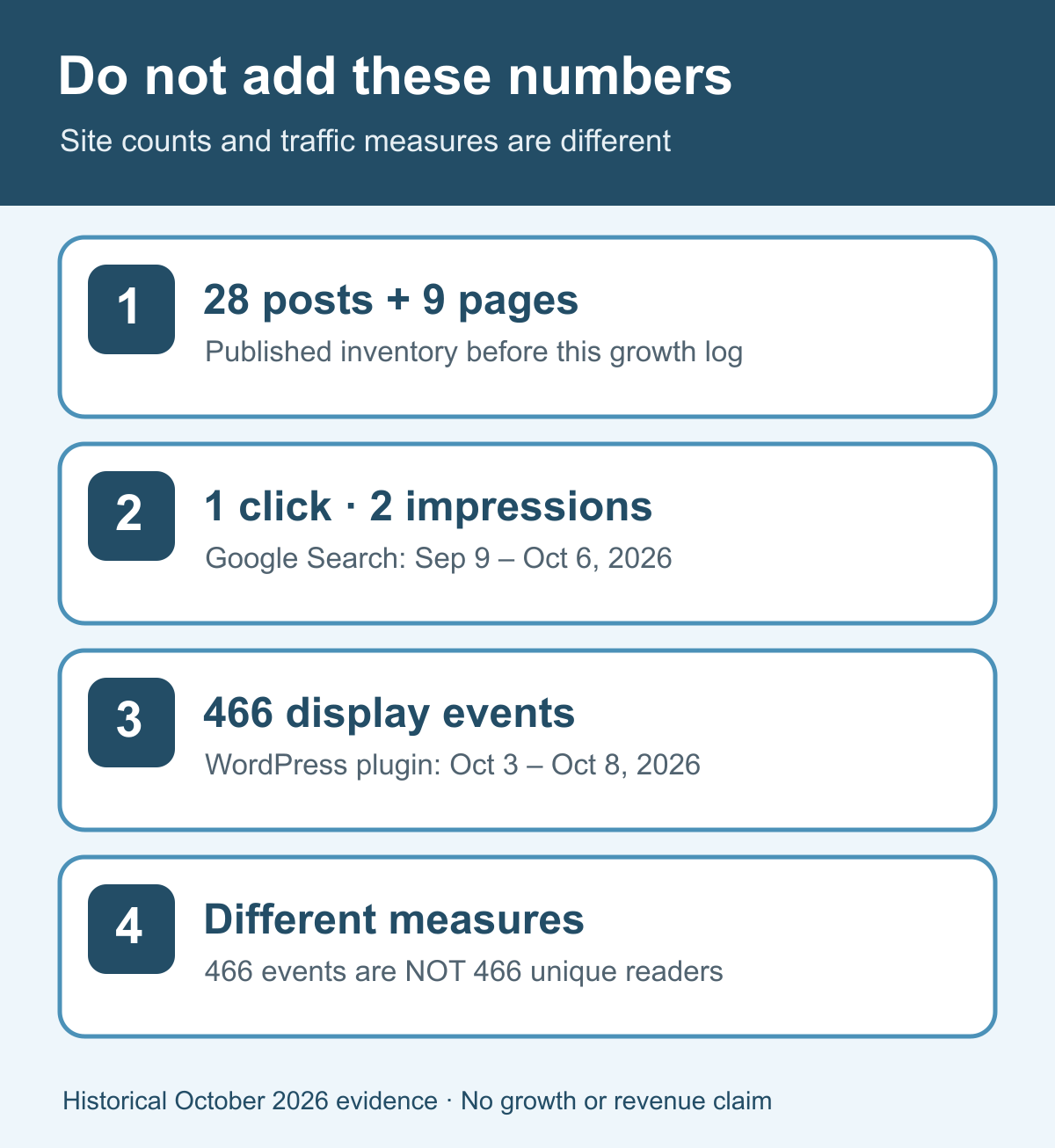
28 posts did not mean 28 articles were being found
Before publishing this entry, I counted 28 WordPress posts and nine static pages.
Google Search Console's finalized data for September 9 through October 6, 2026 showed:
- One Google Search click across the site.
- Two Google Search result impressions.
- The one click was to an older article.
- Data for October 7 and 8 was not yet finalized at the time.
For that time window, organic Google Search discovery was extremely limited.
Meanwhile, a WordPress page-view monitoring plugin recorded 466 display events during October 3–8.
That sounds like more traffic, but it is not evidence of 466 people reading the blog. The plugin may record my own visits, automated checks, or repeated views. It also measures something different from a Google Search click, across a different date range.
The first task was to stop treating those numbers as though they had the same denominator.
Make measurement possible before multiplying content
I wanted to know which articles were discovered, which pages people viewed, and what happened after they arrived. At the start, the evidence was not sufficient to answer all those questions.
I inventoried the existing published posts and static pages, checked Search Console for search visibility, and documented the relevant dates and counting methods.
Then I set up Google Analytics 4 (GA4). I added a single tracking tag through a reversible method, without rewriting the theme, so I could undo the change if necessary.
I also used ChatGPT and GitHub Issues to record investigations and settings changes. That gives future comparisons a change history: if a metric moves, I can ask what else changed at the same time.
The measurement structure was:
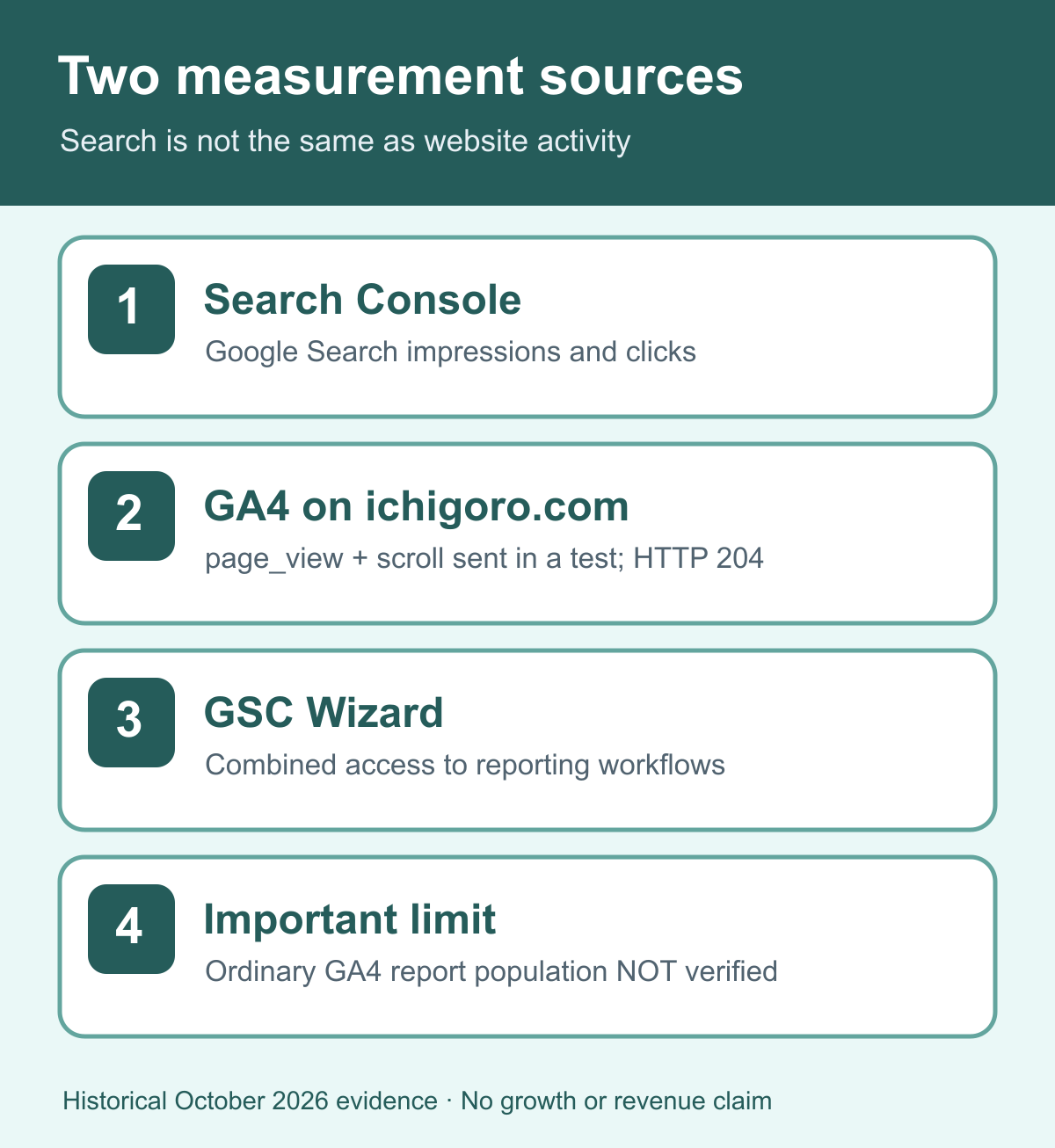
GA4 sent events; it did not prove reader growth
After adding the tag, I opened the site from a test browser and observed page_view and scroll network requests being sent to Google, followed by HTTP 204 responses.
I also completed the reporting connection in GSC Wizard, making it possible to view Search Console and GA4 reports through that workflow.
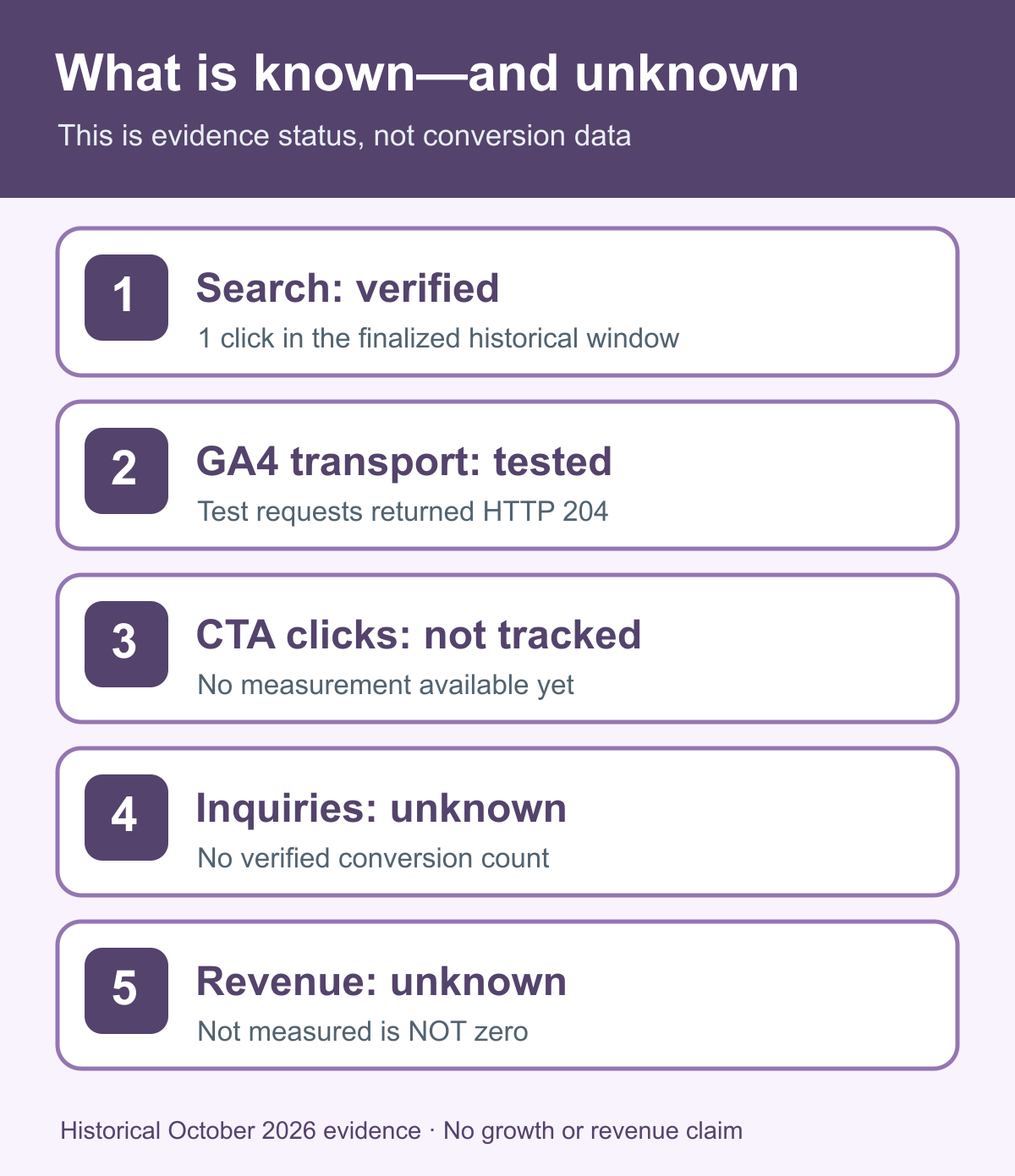
This establishes that those test-browser events were transmitted and acknowledged. It does not, by itself, prove that:
- The GA4 ordinary reporting views had fully populated.
- Any new real reader had arrived.
- Search rankings or click counts had improved.
- A visitor had clicked a contact button.
- An inquiry or sale had taken place.
Installing a tag also cannot reconstruct traffic that occurred before measurement began.
I am keeping “not measured” separate from “measured as zero.” Without that distinction, a business analysis could mistake missing data for a failed or successful conversion.
Privacy and consent were still open questions
I restricted advertising-oriented data use, but that alone did not finish the privacy work. Cookie consent for overseas visitors and consistency with the site's privacy policy still required review.
The fact that a measurement tag is technically working is separate from whether all applicable privacy obligations have been satisfied.
What I planned to do over the next 30 days
I did not want “write an article every day” to become the entire strategy. The more useful question was whether existing articles answered problems that someone was actually looking to solve.
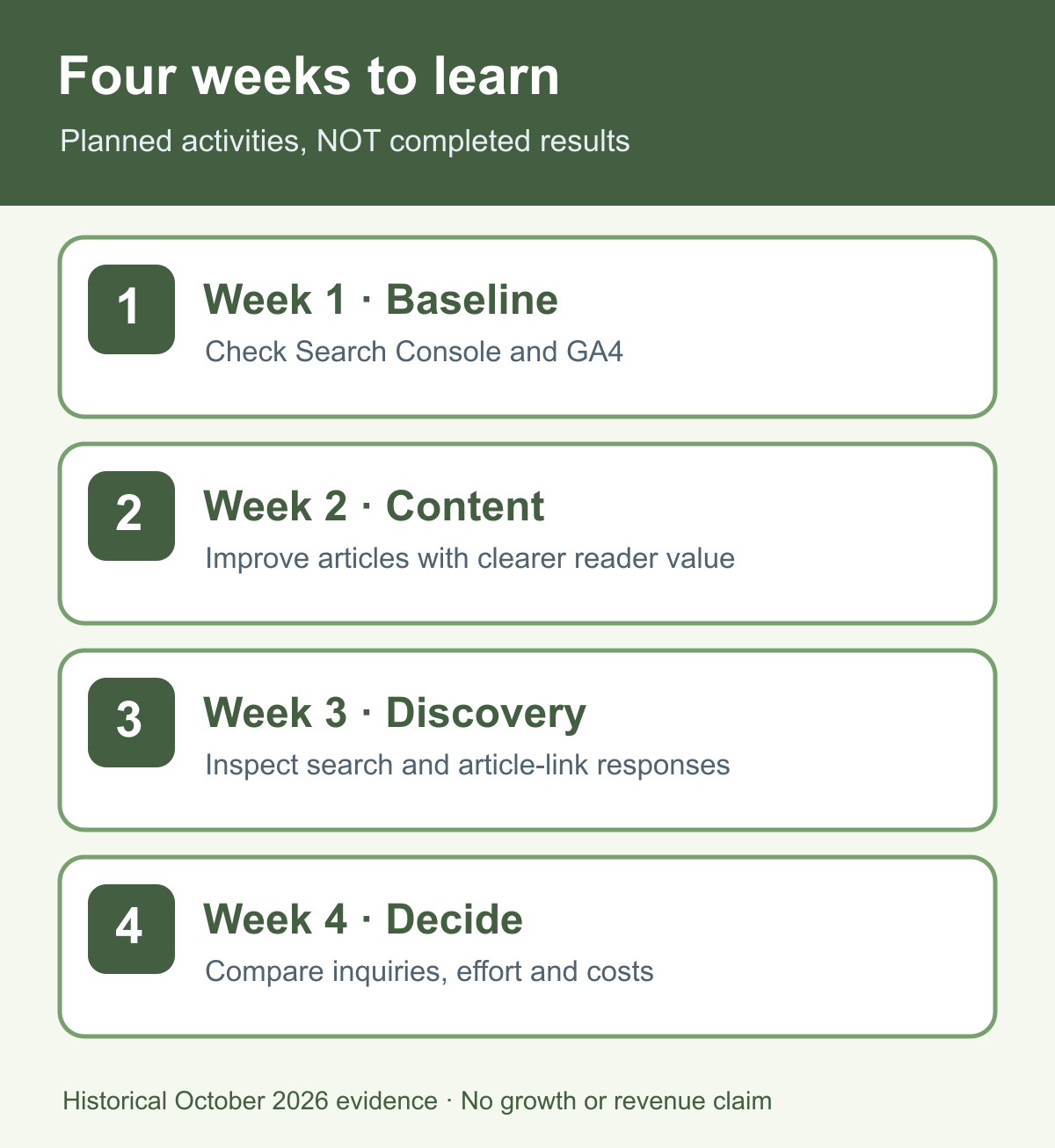
Here was the plan I set out on October 9:
- Week 1: Establish current Search Console and GA4 measurements.
- Week 2: Review existing articles on AI development, automation and engineering work; improve the ones that could answer clearer reader questions.
- Week 3: Study search discovery and article-link responses, and identify still-unmeasured parts of the path.
- Week 4: Compare actual inquiries or other meaningful responses against the time and money invested in revisions. Decide whether to continue, change direction or stop.
If reader response remained weak, the proposed next step was to rethink topics, explanations and calls to action—not just to increase publishing volume. I intended to consider a monetization offer only after observing that readers actually valued something.
Starting from a single search click
At the end of the first day, I had not demonstrated increased traffic or revenue. But I had identified the difference between what was known and what still required measurement.
The point of this growth log is to keep the unsuccessful attempts visible alongside any eventual improvements. AI-generated content is easy to produce; whether it solves a real reader problem and leads to sustained value is a separate hypothesis.
The next planned entry was to decide which of those 28 articles should be improved first.
If you have suggestions about useful measures I am missing, the site's contact page remains the intended way to share them.