Reporting date: October 13, 2026 (JST). Comparison: October 12. GA4 time zone: Asia/Tokyo.
A jump from 10 to 24 pageviews can look like an audience breakthrough. Yet the site recorded three sessions on both days. The available data confirms more page displays, not more independently acquired readers. This log separates those observations from the checks still needed to establish meaningful growth.
More pageviews did not produce more sessions
Google Analytics 4 (GA4) recorded 24 pageviews, 3 sessions, and 3 active users on October 13. The October 12 figures were 10, 3, and 2, respectively. The day-over-day changes were +14 pageviews, no additional sessions, and +1 active user. The chart compares each metric on a consistent within-metric scale. These GA4 values are provisional, and owner visits or browser QA may be included.
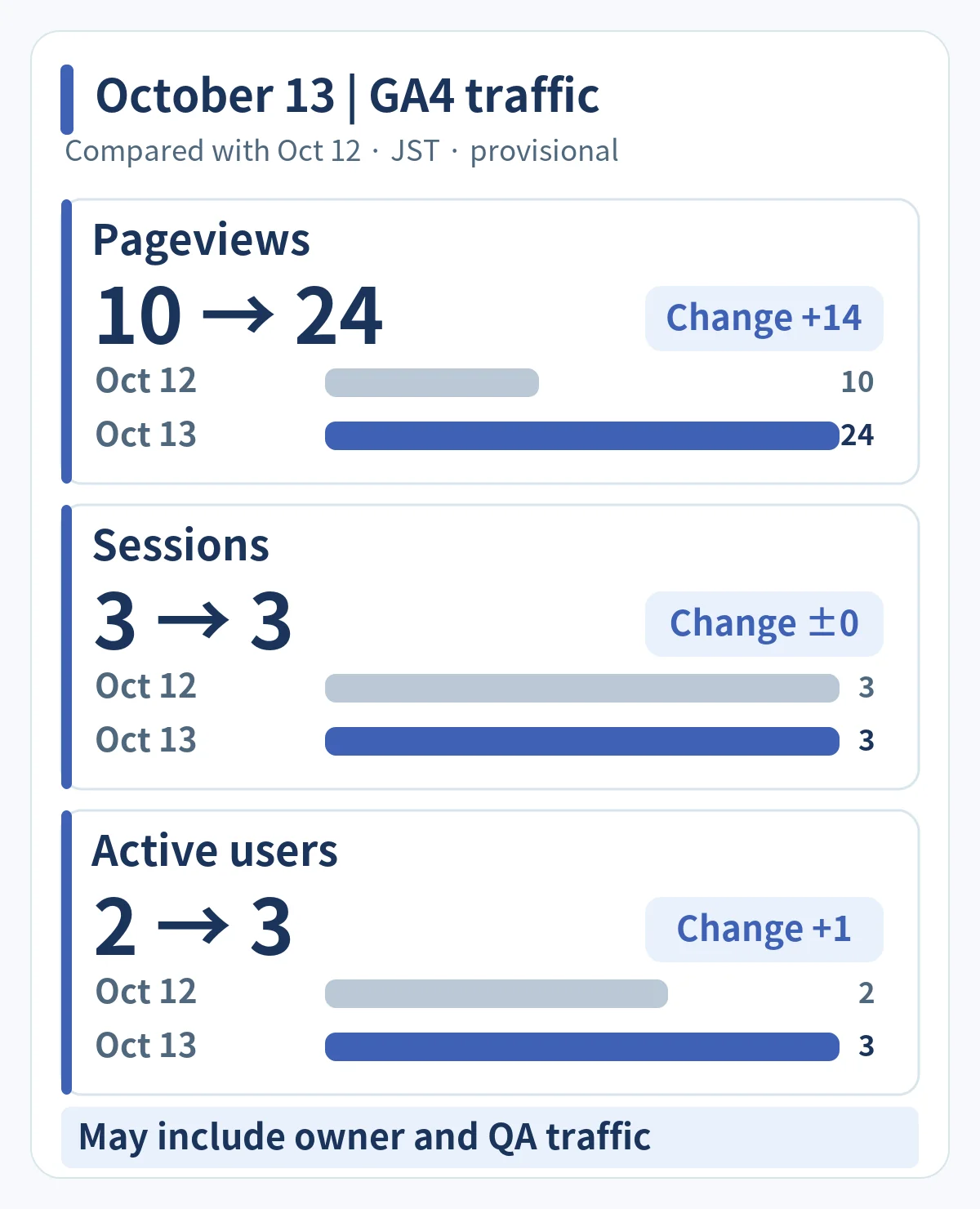
| GA4 metric | Oct 12 | Oct 13 | Change |
|---|---|---|---|
Pageviews (page_view events) |
10 | 24 | +14 |
| Sessions | 3 | 3 | 0 |
| Active users | 2 | 3 | +1 |
| Key events | 0 | 0 | 0 |
Pageviews increase when pages load. One person navigating through several pages or repeatedly checking a newly published article can generate multiple views. Sessions track visits, while GA4 active users are determined by the platform's user-identification and activity definitions. Twenty-four pageviews are not 24 people; three active users are not necessarily three external readers.
One organic-search session is encouraging, not conclusive
GA4 classified two October 13 sessions as Direct and one as Organic Search. The source/medium report attributed the organic session to google / organic. That is a measured channel classification, not an independently verified lead or customer.
Google Search Console (GSC), however, had settled data only through October 11 when checked. Its October 11 web-search figures were 0 clicks and 1 impression, following 0 clicks and 2 impressions on October 10. GSC uses an America/Los_Angeles reporting-date basis, unlike the JST grouping in this GA4 report. October 13 GSC clicks and impressions remain pending; they must not be reported as zero.
The analytics setup also does not yet reliably isolate site-owner sessions and browser testing. We cannot establish whether that single organic session represented a new independent reader.
What we can confirm changed on the site
The live WordPress publication list showed one new article dated October 13. It covers an operational problem with autonomous AI assistants: repeated status reports that fail to translate into useful work. The associated publication record describes a separate explanatory figure and wide cover image, but this review does not establish their current live rendering quality.
Publishing the article is an output. It is not evidence that search rankings, inquiries, or revenue improved as a result. Those outcomes require separate measurements.
Did any visits become inquiries or revenue?
GA4 reported one form_start event on October 13 and zero key events. Starting a form is not the same as submitting it, and it does not confirm a qualified inquiry. We also have no independently validated count of dedicated CTA clicks. CTA performance and actual customer inquiries therefore remain unverified.
GA4 ecommerce showed zero recorded purchase transactions and ¥0 tracked revenue. We have not reconciled any contact records or revenue outside GA4, so this is not evidence that every real-world commercial outcome was zero.
What to measure next
Over the next 7–30 days, the useful question is whether external search visits recur and lead to meaningful actions. We need a way to identify internal QA traffic, then reconcile October 13 search performance when Search Console data settles. CTA clicks, completed form submissions, qualified inquiries, and off-platform revenue should be tracked separately rather than inferred from pageviews.
Assessment: continue validating. October 13 delivered 14 more recorded pageviews but no additional sessions. That warrants observation, not a claim of proven audience or business growth.