Read the original article in Japanese
English adaptation of a Japanese article dated April 9, 2026. Prices in the comparison are historical figures observed on that date, not current offers. Service features, availability and prices must be rechecked before publication.
An English-language interview is not passed by improving grammar alone. You also need to say your answers aloud and develop a usable structure for explaining your experience, reasons for changing jobs, strengths, and setbacks.
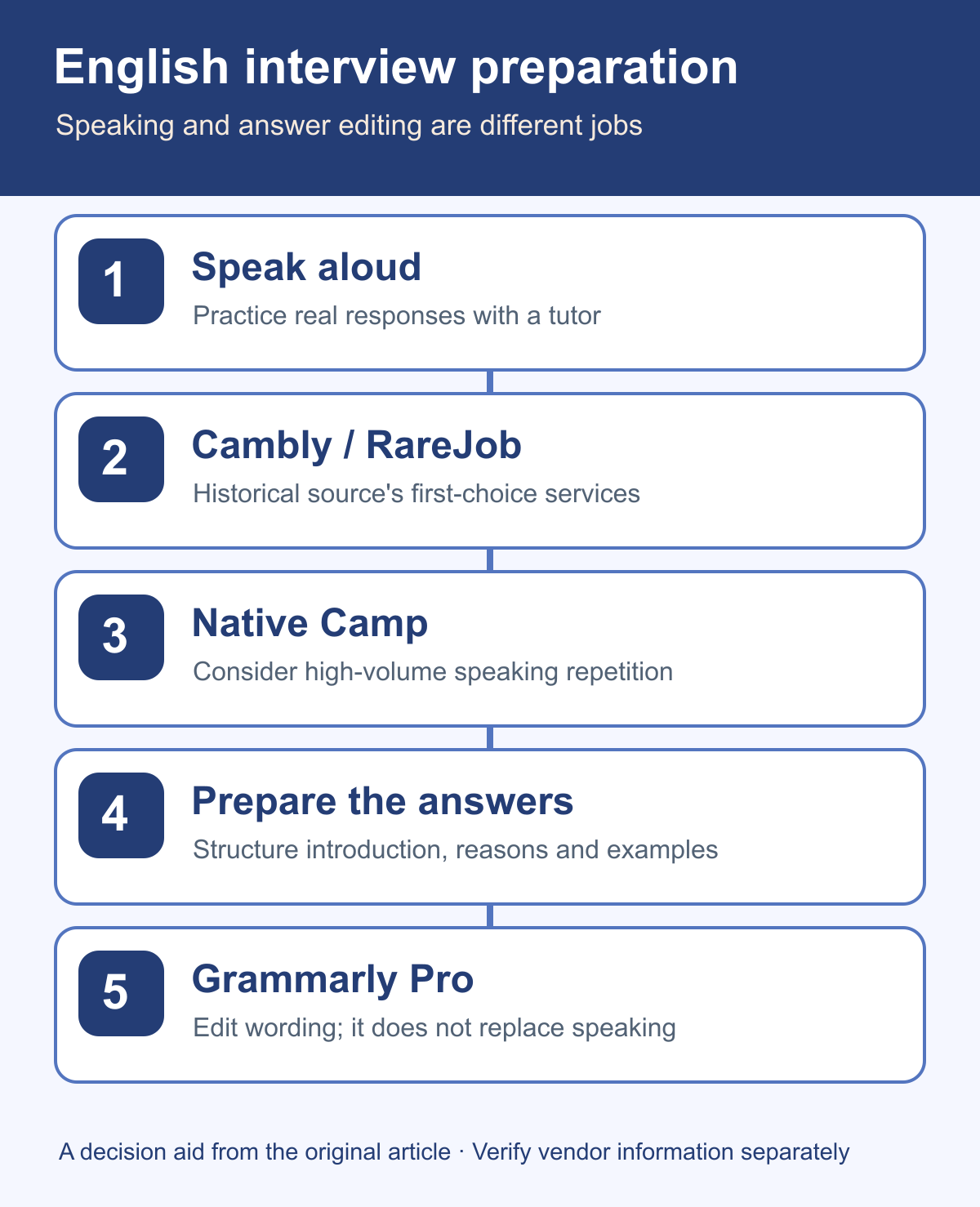
For an IT role at a foreign-affiliated company in Japan, I would separate preparation into two jobs: live speaking practice and answer drafting/editing. This distinction is more useful than buying several courses and hoping they cover everything.
Which tools fit each job?
The Japanese article compared four paid services. Its price observations were made on April 9, 2026 and should not be presented as current quotes.
| Service | Historical price in the Japanese article | Main use |
|---|---|---|
| Cambly | A Pro lesson was shown at US$17.59 per lesson on a 30-minute, once-weekly, monthly-payment example; plan and region affected the price | One-to-one spoken practice, mock interview-style conversations |
| RareJob Business English | ¥12,980/month | Frequent structured business conversation |
| Native Camp Premium | ¥7,480/month, tax included in the cited offer | High-volume speaking practice |
| Grammarly Pro | US$30/month, or an average of US$12/month with annual billing in the cited offer | Editing prepared English answers, resumes, and emails |
These values preserve the historical source and are not purchasing advice at today's prices. Check the official pricing and contract conditions before choosing a service.
The first subscription: practice speaking
Cambly: practice answering a real person
Cambly was attractive for one-to-one conversations with tutors and for revisiting recorded or transcribed lessons, where available under the relevant plan.
That can help you review what you actually said, identify answers that became awkward, and practice again. My view was that this made it a strong option for concentrated interview preparation, though not necessarily the cheapest way to accumulate daily speaking time.
RareJob Business English: build regular speaking habits
RareJob's business course was another first-choice option in the original comparison. The cited format supported daily 25-minute practice. It was not described as a specialized assessment of foreign-affiliated IT interview performance.
Its potential value is repeated practice in explaining a point briefly and clearly, especially if a predictable routine is easier to maintain than occasional longer sessions.
Native Camp: maximize speaking repetitions
Native Camp's key appeal in the original article was the ability to have many lessons under its then-current plan arrangement.
I would use this primarily to lower the friction of speaking English frequently. That is different from a highly realistic mock interview with targeted professional feedback.
The second tool: polish prepared answers
Grammarly Pro: editing, not conversation practice
Some interview questions allow substantial preparation: your introduction, why you want the job, career changes, achievements, setbacks, and questions you will ask the interviewer.
Grammarly Pro was suggested as an editing tool for these materials, along with an English resume or application emails. More natural wording can help you prepare, but Grammarly itself does not give you the experience of responding aloud under time pressure.
The original recommendation was therefore a speaking service plus an editing tool only if both needs were present.
Combinations that make sense
- Near-realistic one-to-one interviews: start by evaluating Cambly.
- Consistent, budget-conscious business speaking practice: evaluate RareJob Business English.
- As much speaking repetition as practical: evaluate Native Camp.
- If the wording of your prepared answers is holding you back: add an editing tool such as Grammarly Pro, after checking its current terms.
The most valuable combination is not necessarily the one with the most subscriptions. Pick a primary bottleneck first and pay only for the second tool when there is a distinct need.
Three mistakes I would avoid
Reading sample answers without speaking them. Understanding a sentence on paper does not mean you can produce it confidently in a conversation.
Trying to sound perfect immediately. Start with a short, understandable answer that gives the conclusion first. Refine it through practice.
Inventing every answer from scratch in the interview. Prepare a structure for common questions, but practice adapting it so you do not sound like you are reciting a memorized script.
FAQ
Which service would I start with? In the April 2026 source, I favored Cambly for mock-interview style practice or RareJob for routine business speaking. Today's choice depends on actual plan features, availability, prices, and your needs.
Is Grammarly enough? Not for interview speaking practice. It helps with written preparation.
Must every tutor be a native speaker? No. At the beginning, simply increasing the amount of comprehensible spoken practice can be valuable. More interview-specific feedback may matter closer to the interview.
Sources for pricing rechecks
For the wider job search, see the comparison of recruiting services for IT jobs at foreign-affiliated companies in Japan.