Read the original article in Japanese
English adaptation of the third chapter of the Japanese 2023 serialized diary. It preserves the author's anecdotes and asides without claiming independent verification or drawing general conclusions about any nationality or workplace.
A change made during the US weekend causes trouble for a Japanese customer on Monday. The next few days become a struggle over incident reports and different expectations about what needs to be explained.
The diary then returns to new colleagues, odd communication, and a less-than-ideal incident handoff.
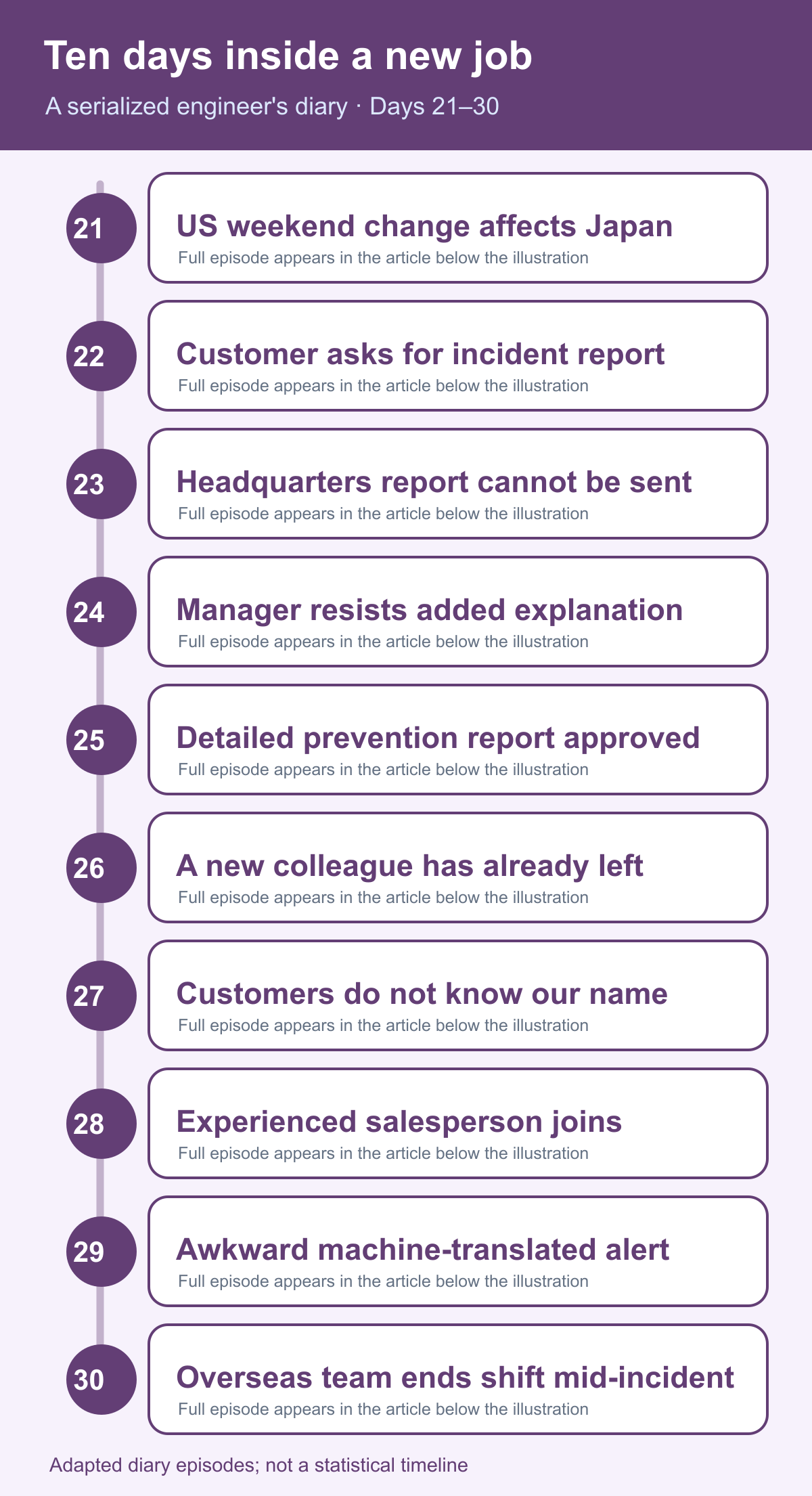
Day 21 — A weekend change breaks Monday in Japan
The team made a system change during the US weekend.
On Monday, we discovered that it had affected a customer in Japan. Suddenly, there was a real problem to deal with.
Day 22 — The customer wants an incident report
The Japanese customer requested a formal report on the previous day's problem.
The engineers back at headquarters did not seem to understand how serious the customer considered the incident.
Day 23 — A report we could not send
The incident report sent by headquarters was not something I could hand to the Japanese customer in its current form.
Aside: “Japanese customers can ask very detailed—and difficult—follow-up questions.”
Day 24 — The boss pushes back
I told my American boss that the customer wanted more explanation and preventive measures.
His response was essentially:
“Customers in the US don't ask for this kind of thing. Maybe you're explaining it badly. I don't know.”
That was not much help.
Day 25 — An agreement at last
I kept explaining the Japanese customer's expectations and showed our previous correspondence.
Eventually, my boss understood. He agreed that I could attach the company logo to the more detailed incident report and recurrence-prevention measures I had prepared, and send them to the customer.
Aside: “The first step was getting the boss at headquarters to understand the difference in customer expectations.”
Day 26 — The salesperson is already gone
The salesperson who joined after me—the one whose Japanese I struggled to understand—was already gone.
According to a rumor, he had decided the company was not a fit.
His LinkedIn profile still showed him as working here, though.
Day 27 — Nobody recognizes the company name
Whenever I called a customer and introduced myself using the company name, they asked me to repeat it.
We're not some suspicious real-estate outfit with an obscure katakana name!
Day 28 — A star candidate joins
A salesperson with an impressive career at the leading company in our industry joined us.
He carried himself like someone exceptionally capable.
But why would someone with that background move to a much smaller competitor? I could not help wondering.
Day 29 — A well-meant machine translation
An operations colleague in the US, who had been studying some Japanese, copied a Google Translate result into an email explaining a system alert.
I appreciated the gesture, but the English original would have been much easier to understand.
Aside: “I'm sure he meant well.”
Day 30 — The shift ends before the incident
Even while we were in the middle of a production incident, engineers on the overseas team finished their shifts and left at the scheduled time.
I was still dealing with the problem.
This is the narrator's experience of a specific incident, not a claim about all engineers outside Japan.
The theme of the third chapter
The first five days form a single escalation: an operational change, a demanding customer, a report that did not fit local expectations, and an eventual agreement on a more detailed response.
The remaining entries return to the unexpected frictions of daily working life. The contrast between different expectations—what deserves explanation, how much notice a customer expects, and who remains available during an incident—drives the story.
Previously: Days 11–20.