Read the original article in Japanese
When considering an IT job at a foreign-affiliated company in Japan, English is often the first thing people worry about. Should you improve your speaking skills? Is a TOEIC score important? How should you handle interviews in English?
Those questions matter. But stronger English will not help much if you are unclear about the roles you want, the value of your experience, or the examples you would give in an interview.
It helps to prepare in a different order: understand the market, explain your work in terms of results, narrow your target employers, and organize your interview stories. Then practice expressing those stories in English.
This is a preparation framework, not a universal hiring rule. Language expectations differ by company and position.
The diagram below summarizes the main idea of this article: before spending too much time polishing your English, it helps to organize your career story, your achievements, and the IT roles you are targeting.
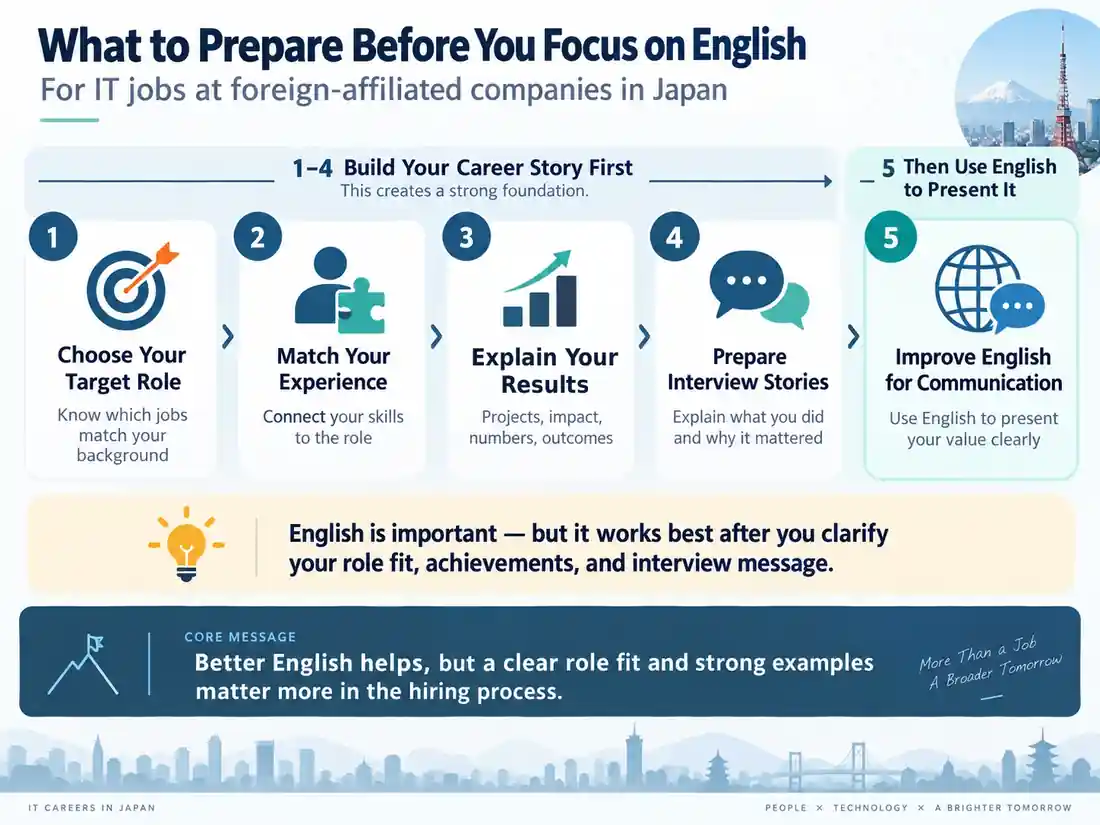
Five things to prepare before polishing your English
1. Understand where your experience fits in the job market
“I want a higher salary” is an understandable starting point. It is not yet a job-search strategy.
Before applying, identify the roles that match your skills, the industries you want to work in, and the compensation ranges you intend to investigate. Then look at what employers actually ask for.
You do not need to settle every detail immediately. But if you cannot explain which roles fit your experience, it will be hard to choose applications or prepare meaningful interview answers.
Recruitment services can be one way to test your assumptions. Look at the positions they suggest, the requirements in those postings, and any responses to your profile. Treat those signals as information about the market, not proof of your personal “market value.”
2. Describe outcomes, not just responsibilities
A list of duties explains what you were assigned to do. It does not necessarily show what changed because of your work.
For each project, ask:
- What problem did I work on?
- What was my role or decision?
- What changed after the work?
- Who benefited, and how do I know?
- Do I have a reliable number or a concrete observation to support the result?
For example, “maintained a system” identifies a responsibility. Explaining which issue you resolved, what changed in the process, and what evidence you have is more useful in an interview.
Do not manufacture percentages or savings to make an achievement sound impressive. A well-explained qualitative result is better than an invented metric.
You should be able to tell this story clearly in Japanese before trying to tell it in English.
3. Decide which kind of employer you are targeting
Companies grouped under “foreign IT” are not interchangeable.
A SaaS provider, cloud vendor, advertising-technology company, and consulting firm may look for very different experience. A Japanese company with international operations is another category again, not automatically the same type of employer.
Think about where your experience is relevant. Then adjust your preparation to the role, rather than trying to use the same generic answer everywhere.
This also helps with the question “Why do you want to join us?” A specific explanation of the work and employer is stronger than a broad claim that you want an international environment.
4. Use recruitment services to learn what roles are available
It may be more productive to look at actual vacancies before spending months on general English study.
A recruitment service can help you see which kinds of jobs appear in your target area, which requirements are common in those listings, and whether your background attracts interest.
The objective is not to apply indiscriminately. It is to make your preparation more concrete. If the roles you want require English presentations or interviews, you have a clearer reason to practice those specific tasks.
Treat recruiters' suggestions and responses as partial feedback. They do not guarantee an offer, salary, or a particular interview process.
5. Build your interview answers before rehearsing them in English
You do not need difficult vocabulary to answer a question for which you have no clear content.
Start with short outlines for:
- Your professional background.
- Why you are considering a change.
- A project or result you can explain.
- A difficult situation or mistake and what you learned.
- Why this particular role or employer interests you.
Each answer should be based on something you can substantiate. The point is to decide what you want to say, then practice how to say it naturally in English.
That way, English practice becomes connected to the job you are actually seeking.
Why English preparation often takes over
English feels like a visible problem. You can track lessons, vocabulary lists, or listening practice. It is less obvious how to measure “understanding the market” or “explaining my work.”
There is nothing wrong with English study. The problem is using it to postpone harder questions about your career.
Interviews may evaluate your reasoning, achievements, ability to repeat results, and fit with the role as well as communication skills. Which factors matter most depends on the employer and position.
A practical order of preparation
First: Write down about five achievements or decisions
Think about improvements, projects, difficult decisions, or problems you solved. For each one, record your role, actions, observed outcome, and what evidence you could share appropriately.
Five is a useful starting exercise, not a hiring requirement.
Next: Test your target roles against actual job postings
Compare your experience with the positions you might apply for. Recruitment services are one source of information. You can also read individual job descriptions carefully.
Note where your current skills match the requirements and where preparation is needed.
Then: Prepare short interview outlines in English
Build answers from the examples you have already organized. Practice describing them accurately, not just memorizing sophisticated phrases.
Refine pronunciation, grammar, and fluency as you go. This approach does not mean postponing English indefinitely; it gives your language practice a concrete purpose.
Three traps worth avoiding
Buying more English-learning materials without choosing target roles. Study may continue, but it does not clarify what a particular employer wants to know about you.
Practicing interview delivery before preparing the substance. Fluency alone cannot make an unclear achievement persuasive. Work on the examples and the English together, beginning with the substance.
Choosing employers solely by advertised pay. Compensation matters, but a role that does not match your strengths or objectives may be a poor fit. Compare the work, requirements, and actual responses as well.
Frequently asked questions
Can I leave English until later?
No. English can be central to a role, and some employers may expect it from the first interview.
The point is not to ignore English. It is to avoid treating English study as a substitute for understanding your experience and your target jobs.
Do I need a TOEIC score?
It depends on the employer and role. A test score may be relevant, but you should not assume it is either universally required or enough on its own.
Check the specific vacancy and prepare to explain your work and communicate in the situations the role involves.
Where should I start this week?
Write down several concrete examples of your work. Review real job postings for the roles you want. Then draft an outline of how you would explain those examples in an interview.
Use that material to direct your English practice.
Start with the substance, then practice the English
For an IT job change to a foreign-affiliated company in Japan, English is important, but it is only one part of preparing a credible application.
Understand the roles you want, explain what you have accomplished, and build clear interview answers. With those pieces in place, English practice can become more targeted and useful.