Read the original article in Japanese
You may be putting substantial effort into your work yet still feel uncertain about your performance review. Someone else may seem less busy but receive a stronger rating.
That does not automatically mean the process is unfair or that your work lacks value. It may mean the expectations, the evidence of your results, and your manager's understanding of your work are not aligned.
A practical response is to clarify what good performance looks like before the review, keep a record of your contributions, and use one-on-ones to check priorities rather than just report activity.
Review systems vary among employers and teams. The suggestions here are ways to make expectations clearer, not claims about every foreign-affiliated company in Japan.
The diagram below summarizes five practical habits for discussing expectations and documenting your work. It is a general framework, not an employer policy.
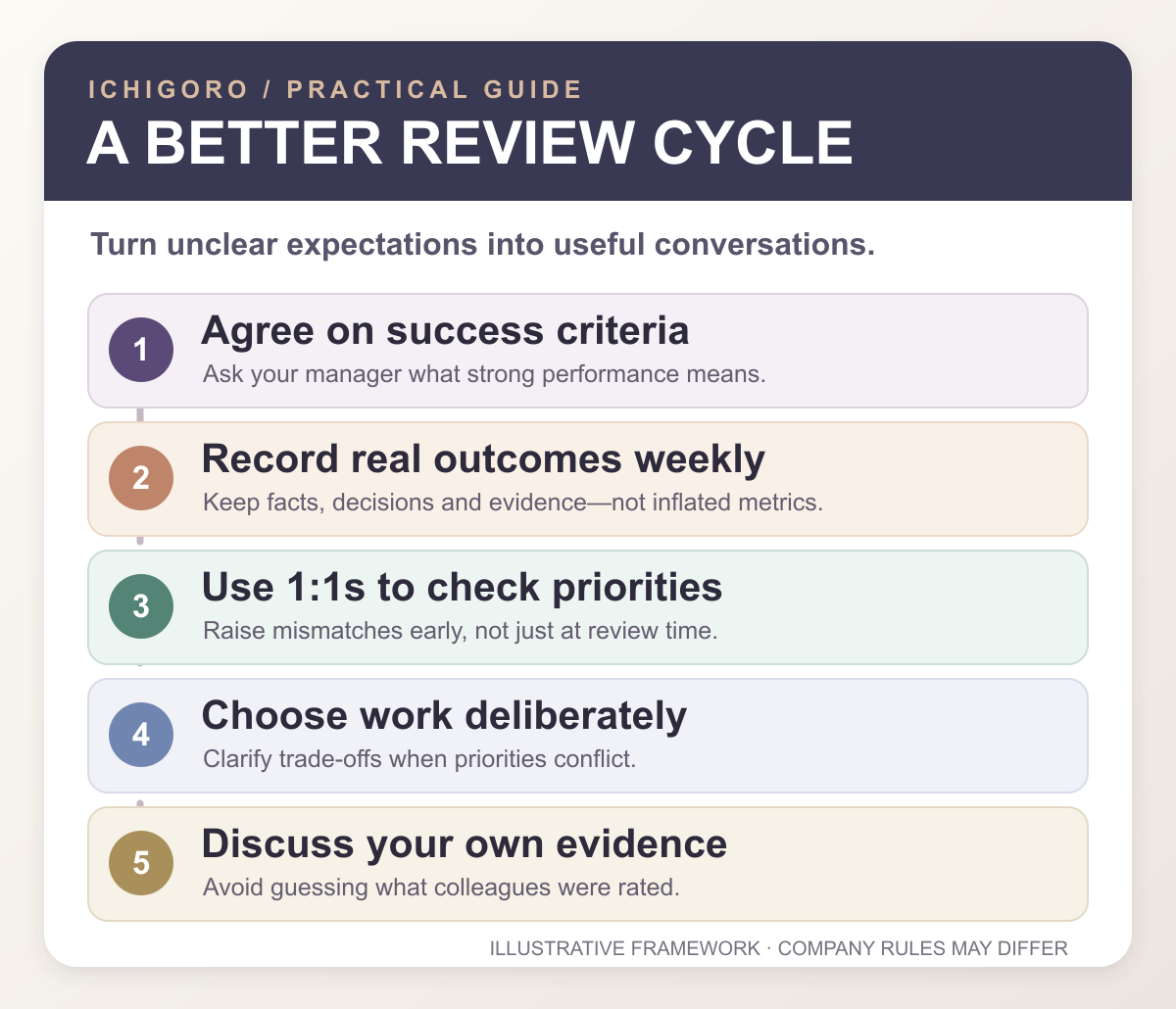
The challenge: Good work and a clear performance case are different things
A performance framework may list competencies and goals. Yet reading that framework does not always tell you how your manager will interpret those goals in your particular role.
It helps to distinguish three questions:
- Did I deliver useful work?
- Can I show what changed and why it mattered?
- Was that work aligned with the priorities I was expected to meet?
The answers may differ. A technically difficult task can be valuable to the team without necessarily addressing the most important goal for that review period.
This is why discussing expectations early is often more effective than waiting until you receive a rating.
Five ways to reduce uncertainty around your review
1. Ask what strong performance would look like at the start
Do not stop at filling in a goal-setting form.
Ask your manager how your goals will be judged in practice. For example:
What would strong performance look like in this role during this review period?
If your company uses quarterly reviews, you can ask what progress should be visible by the end of the quarter. If it uses another cycle, adapt the question to that schedule.
The goal is a shared understanding of outcomes and priorities. A manager may not be able to promise a rating, but they should be able to discuss what the team needs.
Revisit the discussion if the role or priorities change.
2. Keep short notes about your contributions every week
Trying to reconstruct months of work just before a review is difficult.
A small weekly record can be enough. Note:
- What you worked on.
- What improved or changed.
- Who was affected.
- What evidence supports the change, including a number if one genuinely exists.
- Any decisions or trade-offs worth explaining.
Do not inflate an estimate to make the work sound bigger. Clear descriptions help both you and your manager understand what happened.
A record is especially useful when much of your work involves preventing problems, supporting teammates, or making improvements that are not immediately visible.
3. Use one-on-ones for alignment, not only status updates
A one-on-one can become a list of tasks completed since the last meeting. That provides information, but may leave the most important questions unanswered.
Discuss the current priorities, risks, and next decisions.
Useful questions include:
- Am I working on the outcomes you expect?
- Has anything become more important since we last spoke?
- Is there a gap between the work I am doing and what the team needs?
- What should I focus on before our next review?
If something seems misaligned, raise it while there is still time to change direction.
4. Be selective about the work you take on
Helping the team matters. But taking every available task can leave less time for work that has been agreed as a priority.
Some necessary tasks are difficult to connect to formal review goals. That is not a reason to refuse them automatically. It is a reason to discuss their importance and their impact on your existing commitments.
Make a conscious distinction between what you should do now and what can wait. When priorities conflict, ask your manager which outcome matters more.
5. Avoid judging your performance by colleagues' visible activity
You usually cannot see every part of another person's work or the full context behind a rating.
Comparing meeting time, apparent busyness, or a few visible accomplishments may not explain what your colleague was asked to deliver.
Use your agreed expectations as the primary reference point. If the criteria seem inconsistent, ask specific questions about your own goals and evidence rather than guessing what happened in someone else's review.
Common situations and how to handle them
“I worked hard, but my rating was disappointing.”
Start by separating possible causes. Was the work below expectations? Were the expectations unclear? Did you achieve something that was not documented or communicated?
Those are different problems. Ask what evidence or outcomes would have changed the evaluation and how to clarify that earlier next time.
This approach does not guarantee a better rating. It gives you something actionable to discuss.
“The review is near, and I have little evidence ready.”
Do not try to manufacture achievements at the end of the cycle.
Gather what you can support from work records, completed projects, decisions, and observed outcomes. Then set up a simple weekly note-taking habit for the next period.
Earlier alignment is usually easier than trying to resolve every misunderstanding immediately before the review.
“My manager is too busy to provide detailed feedback.”
Instead of waiting for a broad conversation, bring a small number of concrete questions.
You might ask which of your current priorities matters most, where your work is falling short of expectations, or whether your planned approach is still the right one.
A short, focused discussion can be more useful than an open-ended request for feedback.
Habits that make reviews easier to navigate
The source article emphasizes practical habits: explaining outcomes concisely, aligning expectations early, choosing priorities, and continuing to work despite some ambiguity.
These habits cannot remove every problem in an evaluation process. They do help turn vague uncertainty into questions you can discuss and actions you can take.
A useful distinction is between doing the work, recording the outcome, and explaining its relevance. Treat all three as separate parts of preparing for a review.
Frequently asked questions
Are reviews at foreign-affiliated IT companies in Japan stricter than at Japanese companies?
There is no single answer. Formal criteria, manager discretion, team culture, and the work itself differ by employer.
Rather than assuming one type of company is universally stricter, find out how your own objectives and results will be assessed.
Does weaker English automatically lead to a worse review?
Not necessarily. The practical question is whether you can communicate expectations, progress, and results clearly in the situations your role requires.
English may be important for some roles, but language proficiency alone does not explain every performance outcome.
What if I cannot align expectations with my manager?
Try to make the disagreement specific: the priority, the expected result, the evidence, or the timeline. Ask which part needs to change.
If repeated conversations do not resolve a serious mismatch, you may need to evaluate alternatives such as a different team or a different employer. That is a situation-dependent career decision, not an automatic recommendation.
What to do before your next review
Performance reviews become harder to navigate when expectations are vague and your work is difficult to explain.
Start the conversation early. Keep a record of outcomes. Use regular meetings to check whether you are solving the problems your manager considers important.
You cannot control every decision in a review, but you can make your work, priorities, and questions clearer.