Read the original article in Japanese
English adaptation of a Japanese business analysis published April 9, 2026. This is a conceptual evaluation, not evidence of verified revenue from an X automation system.
It is easy to find claims about making money from automated posts on X. AI can help produce drafts, maintain a publishing schedule, and run content experiments. But publishing more posts is not the same as selling a product.
The real questions are who you are trying to reach, what problem they have, what you can sell them, and how they move from an interesting post to an actual decision.
Why AI posting automation gets attention
“Let the AI post for you” is a vivid promise. It can reduce the cost of generating ideas, help sustain output, and make it easier to test different angles.
Those are genuine operational possibilities. However, increasing content volume can also increase low-quality repetition or platform-policy risk. It does not prove that the audience has a problem worth paying to solve.
That distinction is where many automation-first business plans become weak.
What actually determines sales?
Suppose an automated account gains attention. The next questions are:
- Who are the people reading the posts?
- Why would those people trust the account?
- What specific problem do they want resolved?
- What product or service addresses that problem?
- Where does the reader go after the post?
- What evidence shows the reader took the next step?
Without answers, impressions and reactions may remain vanity metrics.
X often serves as an entry point rather than the entire purchasing journey. A profile, pinned post, newsletter, LINE, landing page, or product page may connect an initial impression to a more meaningful action. Which channel is appropriate depends on the audience, consent and platform rules.
The six-stage model
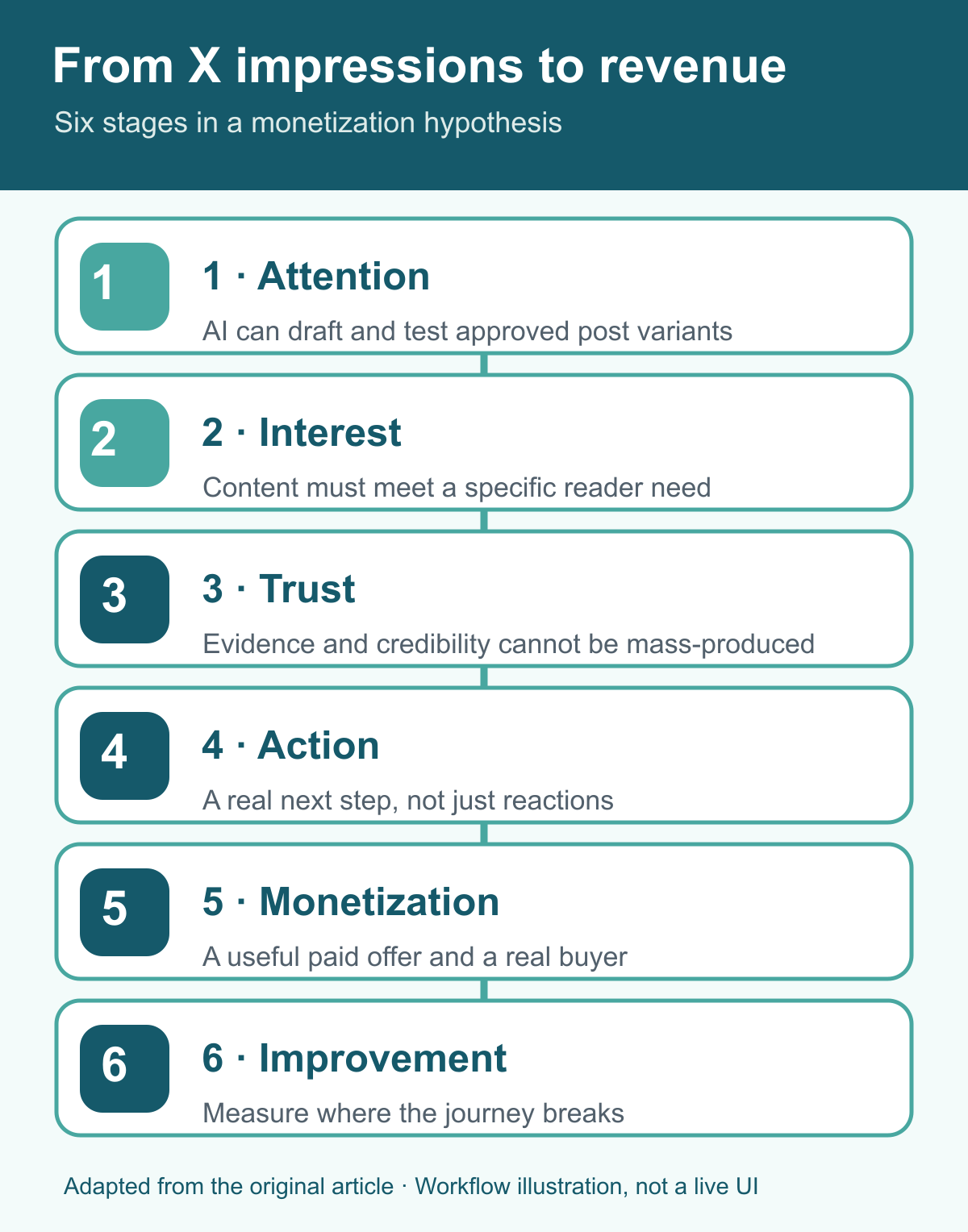
I find it useful to break a monetization journey into six stages:
- Attention: a potential customer notices the content.
- Interest: the topic matches a real need.
- Trust: the person sees credible reasons to keep listening.
- Action: the person clicks, signs up, requests information, or takes a relevant step.
- Monetization: the offer produces a legitimate sale or other revenue event.
- Improvement: performance data and feedback inform what to change.
AI posting automation may strongly affect the first two stages. It may also help collect and summarize data. But it does not automatically design a valuable product or establish trust.
Which tasks can be automated?
Good candidates include drafting multiple post variants, organizing ideas, scheduling within platform limits, reusing approved templates, and collecting permitted interaction statistics.
Harder tasks require judgment: selecting a target customer, defining an honest offer, developing a trustworthy voice, understanding objections, and diagnosing where a funnel loses potential customers.
Automation still needs rate limits, duplicate-post prevention, a kill switch, logging, permissions, and adherence to the X platform rules. Producing spam more efficiently is not a viable business strategy.
Why automation-only attempts may fail
Several predictable failure modes appear:
No clear product. Content output grows, but there is nothing relevant to buy.
No audience definition. Generic topics attract broad reactions without drawing qualified buyers.
Weak next step. A reader enjoys a post but cannot find an appropriate continuation.
Selling before establishing trust. The post immediately pushes an offer without demonstrating value.
A viral post can magnify all four weaknesses. It does not fix them.
Work backward from the offer
Before building an automated posting service, write down three things:
- Who is the target customer?
- What exactly would that person pay for?
- What legitimate path leads from the content to that offer?
Test those assumptions with a small amount of useful content and an observable action. Only then decide which repetitive upstream work should be automated.
This is the opposite of building a large posting machine and hoping a product idea appears afterward.
Automation is an accelerator, not the engine
AI can increase the number of attempts you make to reach and learn from an audience. Whether those attempts become profitable depends on the economics of the offer, the quality of the audience, and the conversion journey.
The same distinction applies to blogs, newsletters, video, and messaging channels. Content creates opportunities for attention; a useful offer and a credible path to it create a business.