Read the original article in Japanese
English adaptation of an April 9, 2026 Japanese opinion article. It reflects one perspective on these workplaces, not a claim that every employer or role operates this way.
Foreign-affiliated IT jobs in Japan are often associated with attractive compensation, autonomy, and clear performance expectations. Those benefits can be real. But someone joining such an organization may also discover challenges that are harder than expected.
In my view, the biggest pressures are not always about the English language. They are often about high expectations, organizational change, having to explain results, demanding coordination, and setting your own boundaries.
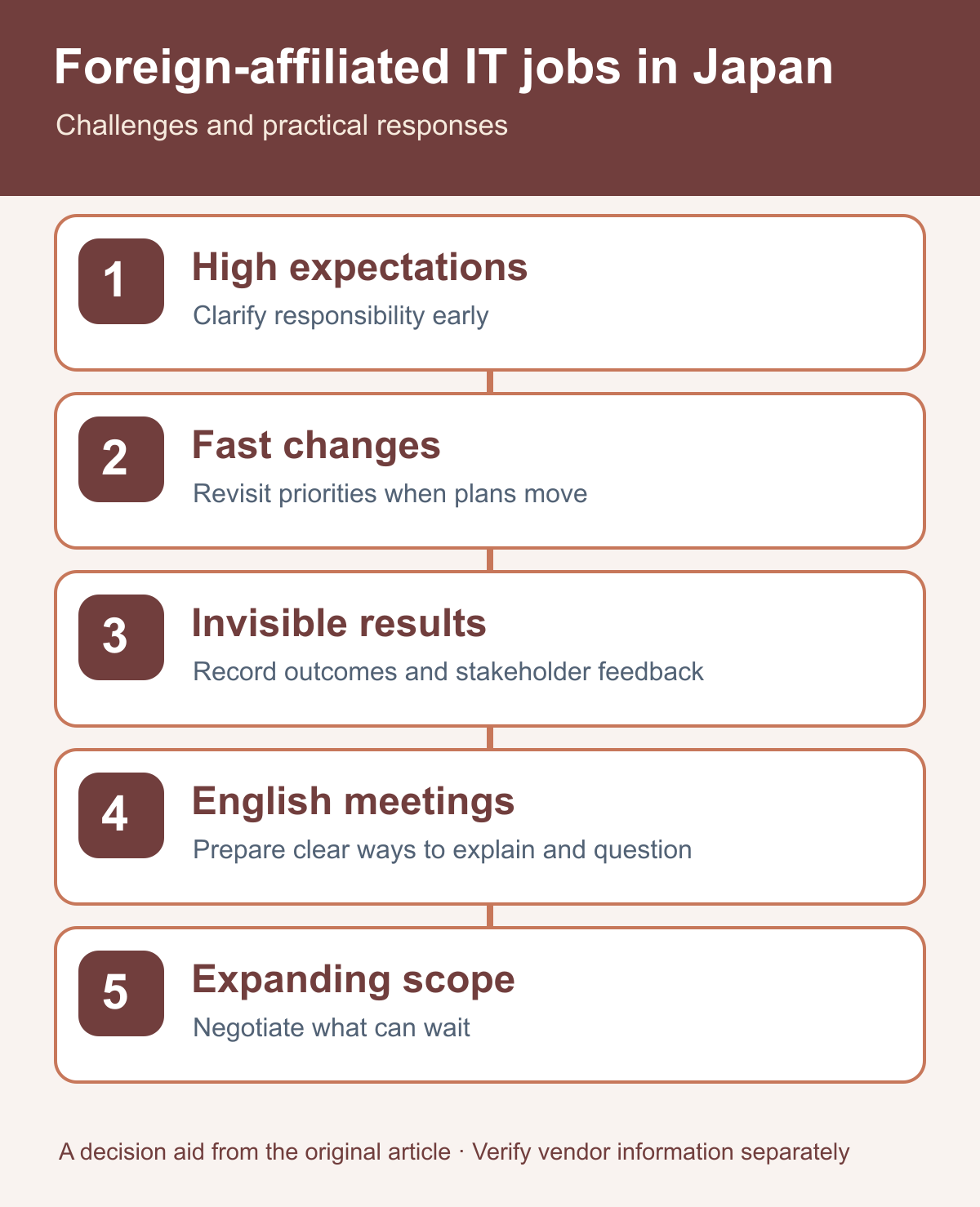
The five situations that can wear people down
1. High expectations from the start
Some teams hire a specialist assuming that the person can operate independently soon after joining. The positive side is autonomy. The difficult side is having to determine how to proceed even while much of the organization is unfamiliar.
If you expect a long, highly structured training period, the gap between expectation and reality may be tiring. The actual level of support varies by company and manager.
2. Rapid changes in priorities and organization
A reporting line, manager, focus area, or project priority may change rapidly. Something important in one quarter can become secondary in the next.
Some engineers find that pace motivating. Others prefer a stable scope and may experience it as disruption. Neither preference is a sign of incompetence; the question is whether the working environment suits you.
3. Delivering value—and explaining it
Finishing a difficult task does not always ensure that its impact is visible. You may also need to describe the result to stakeholders, connect it to team goals, and align expectations with your manager.
I see this as a distinct skill from writing code or operating systems. If the work is invisible, a performance discussion may not reflect how much effort went into it.
A simple habit is to keep notes about delivered outcomes, improvements, and feedback while the details are fresh.
4. Meetings and alignment can be harder than English itself
Being able to read and write English is not the same as negotiating ambiguous requests in an English-language meeting.
The hard part may be thinking, disagreeing politely, asking for clarification, and reaching a decision in real time. Perfection is less useful than a small set of reliable expressions for stating a position and checking understanding.
5. Work keeps expanding unless you manage the boundary
When roles are broad and colleagues are busy, saying yes to everything can make the workload expand indefinitely.
Learn to ask which task should take priority, what can wait, and who has decision-making responsibility. Protecting a manageable scope is part of professional work design, not simply refusing to help.
Why these pressures feel intense
Three conditions reinforce each other:
You need to find your own direction. Autonomy can feel like freedom, but also means there may be no one to supply detailed instructions.
Expectation alignment is part of the job. Completing work and making expectations explicit are both necessary activities.
Adaptability affects performance. If priorities shift frequently, the ability to reset and communicate a plan becomes valuable.
These observations should not be read as a measured foreign-versus-Japanese-company ranking. Teams, industries, leaders, and roles differ widely.
Who might enjoy this environment?
You may enjoy it if you prefer setting your own direction, find a broad role interesting, care about the relationship between results and evaluation, and can adapt to frequent change.
It may be a poor match if you need a narrowly defined role, extended instruction, and detailed supervision. That is a fit question, not a moral judgment.
Four ways to reduce unnecessary strain
- Align expectations with your manager early. Agree on success criteria, scope, and what is not included.
- Keep a record of results. Capture useful evidence for later performance conversations without exposing confidential information.
- Prepare reusable English meeting phrases. Practice clarifying, summarizing, raising objections, and asking for a decision.
- Make priorities explicit. When asked to add something, discuss what will be delayed or deprioritized.
Misconceptions worth challenging
“Good English will make everything easy.” Communication matters, but it does not replace prioritization or managing expectations.
“Higher pay makes every drawback acceptable.” Compensation and day-to-day working fit are different variables.
“More autonomy always means less stress.” Freedom can come with greater responsibility for decisions and trade-offs.
FAQ
Is English the toughest part? It depends on the individual and the role. For some people, high expectations and coordination are more demanding.
Can someone without prior foreign-company experience succeed? That depends more on the role, support, and fit than on the label alone. Assess onboarding and expectations directly.
What if the job feels wrong? Identify whether the difficulty comes from the organization, your manager, the role, or the broader working model before deciding what to change.
Conclusion
A foreign-affiliated IT role in Japan can be rewarding, but do not decide from compensation or an image of freedom alone. Ask about priorities, onboarding, performance evaluation, communication norms, and how the team handles change.
For the next step in a job search, see the comparison of recruiting services.